ALS Ambulance Service | Advanced Life Support Emergency Transportation
Immediate Advanced Life Support (ALS) medical transportation equipped with cardiac monitors, defibrillators, advanced airway systems, emergency resuscitation medications, and critical care paramedics.
When basic medical transportation is insufficient, an ALS ambulance provides advanced prehospital medical support during transport. Henotic Diagnostics provides Advanced Life Support Emergency Transportation for eligible emergency and inter-hospital transfers, with access to diagnostic services when clinically appropriate.
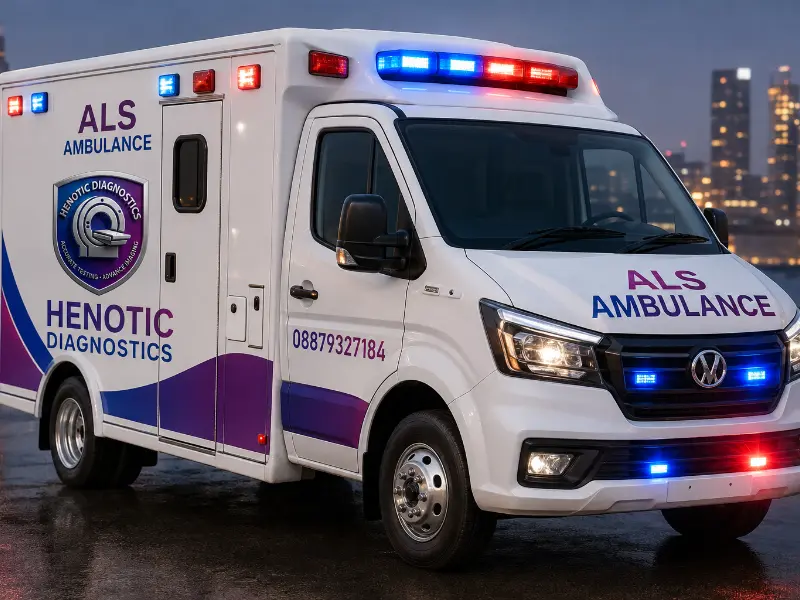
What Is an ALS Ambulance?
ALS stands for Advanced Life Support. An Advanced Life Support Emergency Transportation is designed to provide a higher level of prehospital care for patients who may require advanced assessment, monitoring or intervention during transport.
When Is an ALS Ambulance Needed?
An Advanced Life Support Emergency Transportation is required whenever a patient requires continuous clinical observation, emergency pharmacology, or active intervention en route:
| Patient Situation | Why ALS Support Is Required |
|---|---|
| Cardiac emergencies & chest pain | Patients may require continuous clinical observation and cardiac monitoring during transport. Where required, patients may undergo as part of diagnostic evaluation. |
| Severe respiratory distress & asthma | Endotracheal airway management, nebulization, and high-flow oxygen manifolds. |
| Unstable & high-acuity patients | Continuous invasive vital tracking and emergency IV vasopressor titration. |
| Major trauma & poly-trauma accidents | Spinal immobilization, hemorrhage control, and fluid resuscitation protocols. |
| Altered consciousness & coma | Airway patency protection, Glasgow Coma Scale (GCS) tracking, and oxygenation. |
| Acute stroke & neurological deficits | Rapid medical transport and appropriate clinical monitoring, followed by urgent evaluation and, when indicated, CT scan services. |
| Uncontrolled seizure episodes | Emergency intravenous anticonvulsant administration and suction support. |
| Emergency inter-hospital transfer | Continuous medical supervision during tertiary healthcare facility transfers. |
Onboard Advanced Life Support Equipment
Advanced Life Support Emergency Transportation operate with advanced emergency resuscitation technology:
Ambulance equipment and clinical capabilities vary according to the vehicle configuration, provider scope and applicable local requirements. For international guidance on ambulance equipment and prehospital systems.
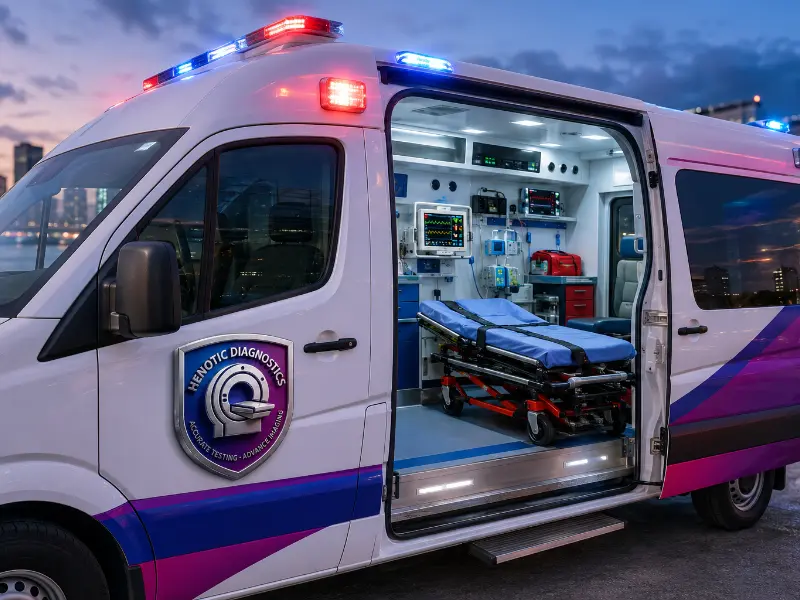
Multiparameter Monitor & Electrocardiogram Services
Continuous tracking of 12-lead ECG, NIBP, SpO2, EtCO2, respiration rate, and core body temperature.
Biphasic Defibrillator
Synchronized cardioversion, external transcutaneous cardiac pacing, and automated defibrillation.
Advanced Airway & Suction
Laryngoscopes, endotracheal tubes, supraglottic airways, high-vacuum suction, and bag-valve masks.
Emergency Resuscitation Drugs
Emergency pharmaceutical kits containing epinephrine, atropine, amiodarone, analgesics, and IV crystalloids.
ALS Ambulance vs Basic (BLS) Ambulance
Compare the clinical capabilities to ensure proper vehicle allocation:
India’s National Ambulance Services framework includes Basic Life Support (BLS), Advanced Life Support (ALS), and Patient Transport Vehicles.
| Basic (BLS) Ambulance | Advanced (ALS) Ambulance |
|---|---|
| Non-invasive basic patient transit | Advanced emergency medical care & resuscitation |
| Basic first-aid & standard oxygen mask | Advanced multiparameter monitors & 12-lead ECG |
| Non-invasive airway support only | Invasive endotracheal intubation & mechanical circuits |
| No emergency IV medication delivery | IV cannulation, emergency infusions & cardiac drugs |
| Staffed by EMT driver & basic attendant | Staffed by certified ALS paramedics & emergency crew |
ALS Ambulance vs ICU Ambulance
Understanding the distinction between emergency field stabilization and intensive critical-care transit:

| ALS Ambulance | Mobile ICU Ambulance |
|---|---|
| Focuses on acute emergency stabilization | Focuses on ongoing multi-organ intensive care |
| Ideal for trauma, stroke, and cardiac events | Ideal for ventilator-dependent & comatose transfers |
| Cardiac monitoring, defibrillation & airway kits | Microprocessor transport ventilators & multi-syringe pumps |
| Staffed by critical care paramedics | The exact staffing and equipment of an ICU or critical-care ambulance vary by provider and patient requirements. The appropriate transport level should be determined by the patient’s clinical condition and the receiving facility’s requirements. |
Specialized ALS Emergency Protocols

Cardiac Emergency Response
Rapid deployment for myocardial infarction (heart attack) and arrhythmias with immediate defibrillation readiness and IV antiarrhythmic protocols.
Severe Respiratory Distress
Emergency CPAP, advanced supraglottic airways, deep suctioning, and nebulized bronchodilators for acute asthma or pulmonary edema.
Major Trauma & Accidents
Spinal motion restriction, cervical collars, traction splints, pelvic binders, and active fluid resuscitation for hemorrhagic shock.
Stroke & Neurological Triage
Standardized stroke assessments, blood glucose verification, airway protection, and priority green-corridor hospital routing.
Hospital-to-Hospital ALS Transfer Protocols
When patients need to move between medical centers for specialty procedures or higher-level intervention, our Advanced Life Support Emergency Transportation provide seamless bed-to-bed clinical continuity:
| Transfer Requirement | ALS Transportation Protocols |
|---|---|
| Cath Lab & Angioplasty Transfers | Continuous ECG rhythm telemetry and heparin/nitro infusion monitoring. |
| Specialist Emergency Surgery | Hemodynamic maintenance with pre-arranged surgical team handover. |
| Trauma Center Escalation | Full immobilization and continuous vital stabilization during transit. |
| Transfer for Advanced Diagnostic Evaluation | Medically supervised transport when a patient requires assessment or diagnostic procedures at another healthcare facility, subject to clinical suitability and receiving-facility arrangements. |
How to Book an ALS Ambulance in 5 Steps
Describe Emergency
Share patient symptoms, consciousness, and breathing stability.
Specify Needs
Mention cardiac monitoring, oxygen, IV support, or trauma care.
Confirm Address
Provide exact pickup building, floor number, and receiving hospital.
Priority Dispatch
Nearest ALS vehicle is mobilized with immediate crew tracking.
Information Required for ALS Booking
| Information | Clinical Importance |
|---|---|
| Patient Consciousness Level | Determines immediate airway management readiness and crew configuration. |
| Breathing & Pulse Status | Prepares bag-valve masks, oxygen flow rates, and defibrillator leads. |
| Known Medical History | Alerts paramedics to cardiac history, diabetes, stroke, or allergies. |
| Exact Pickup Landmark | Eliminates routing delays and enables rapid paramedic entry. |
| Destination Trauma Center | Allows crew to pre-alert receiving emergency casualty doctors. |
Providing accurate information helps the dispatch team determine the appropriate ambulance configuration and prepare for the patient’s needs.
Transparent ALS Ambulance Pricing Factors
ALS ambulance pricing is clear and based on patient clinical complexity and distance:
| Pricing Determinant | Cost Impact & Structure |
|---|---|
| Travel Distance | Local emergency transit vs long-distance inter-city medical shifting. |
| Equipment Configuration | Standard ALS unit vs specialized cardiac and multi-infusion setup. |
| Medical Staffing | Critical care paramedic crew vs specialized doctor accompaniment. |
| Handover Time | Bedside casualty stabilization and admission processing duration. |
Call 08879327184 for current ALS ambulance pricing and availability.
Why Choose Henotic Diagnostics ALS Ambulances?
- ACLS trained paramedics and trauma specialists
- Hospital Pre-Alert Protocols: Calibrated 12-lead ECG telemetry, biphasic defibrillators, and multi-vital monitors.
- Direct Human Helpline: Instant connection to trained medical dispatchers with no automated call delays.
- Hospital Pre-Alert Protocols: Direct casualty room communication for zero-wait emergency room handovers.
- Strict Sterilization Standards: Complete medical vehicle decontamination and sanitized clinical interiors.
Frequently Asked Questions
What does ALS mean in an ambulance?
ALS stands for Advanced Life Support. An Advanced Life Support Emergency Transportation provides high-level emergency medical care, including cardiac monitoring, defibrillation, advanced airway intubation, and emergency IV medication administration.
When should I book an ALS ambulance?
Book an ALS ambulance for critical medical emergencies such as heart attacks, chest pain, acute breathing difficulty, severe trauma, stroke, unconsciousness, or high-risk inter-hospital transfers.
Does an ALS ambulance have a defibrillator?
Yes. ALS ambulances may be equipped with defibrillation and advanced cardiac-monitoring equipment depending on the ambulance configuration and applicable service standards. Henotic’s available equipment should be confirmed when booking.
What is the difference between ALS and BLS ambulance?
A BLS (Basic Life Support) ambulance handles non-invasive, stable patient transport. An ALS (Advanced Life Support) ambulance provides advanced invasive airway management, cardiac telemetry, defibrillation, and emergency intravenous medications.
Can an ALS ambulance transport stroke patients?
Yes. ALS ambulances provide rapid emergency transportation, continuous physiological monitoring, and pre-arrival notification to stroke-ready hospitals.
Can an ALS ambulance be used for hospital transfer?
Yes. ALS ambulances are widely used for inter-hospital transfers when a patient requires continuous medical observation, cardiac monitoring, or IV medication support.
Is an ALS ambulance the same as an ICU ambulance?
While both provide advanced care, an ALS ambulance focuses on emergency stabilization, resuscitation, and rapid transport. An ICU ambulance is designed for ongoing multi-organ intensive care and ventilator-dependent hospital transfers.
Can an ALS ambulance handle cardiac emergencies?
Yes. It is specifically equipped for cardiac emergencies with continuous 12-lead ECG monitoring, defibrillators, oxygen therapy, and emergency cardiovascular pharmaceuticals.
How fast can an ALS ambulance reach?
Dispatch begins after booking confirmation. Arrival time depends on vehicle availability, traffic, pickup location and current emergency demand. Call 08879327184 for the latest estimated arrival time.
How much does an ALS ambulance cost?
Pricing is distance-based and determined by medical equipment configuration and paramedic staffing. Call 08879327184 for immediate transparent pricing.