

Stretcher Ambulance — Safe Transport for Bedridden Patients
Stretcher Ambulance from Henotic Diagnostics provides dedicated, medically supervised transport for patients who cannot sit upright or walk. In addition, every vehicle comes fitted with hydraulic stretchers, a trained patient-handling crew, oxygen support, and continuous vital monitoring throughout the journey.
CALL NOW: 088793 27184
What Is a Stretcher Ambulance?
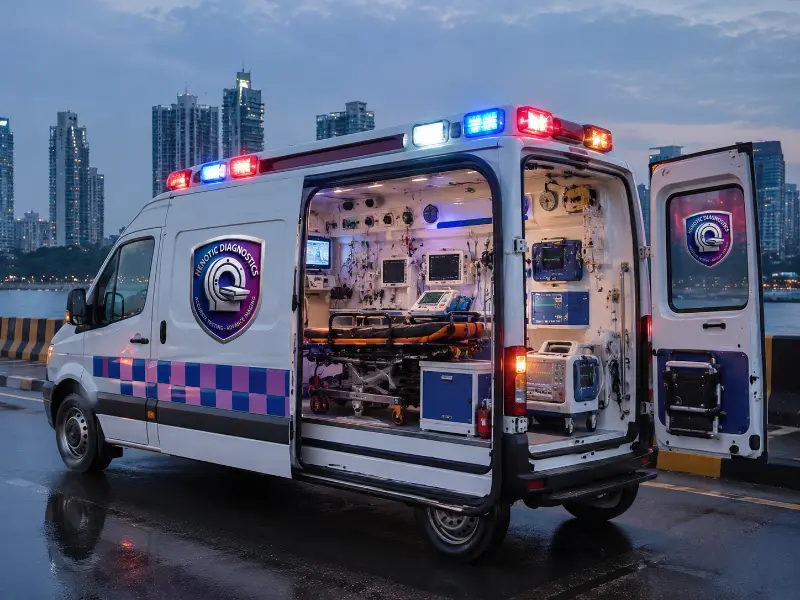
A stretcher ambulance is a medical transport vehicle built to carry patients in a lying-down position on a secure, adjustable stretcher. Specifically, it serves patients who cannot sit, stand, or walk — including bedridden people, post-surgery patients, elderly individuals with limited mobility, and those who need oxygen or monitoring during transit.
Unlike a regular vehicle or wheelchair transport, this type of ambulance offers a controlled medical setting with proper patient positioning, safety straps, and on-board medical gear. As a result, the patient stays safe and comfortable throughout the ride. Our service follows NAEMT patient transport guidelines and WHO safe patient transfer standards.
When Do You Need a Stretcher Ambulance?
In particular, a stretcher-based ambulance is the right choice whenever a patient needs to travel lying flat and cannot safely use a regular car, taxi, or wheelchair transport:
Hospital Discharge
After surgery, treatment, or a long hospital stay, patients often need a safe stretcher transfer from the hospital bed to their home.
Inter-Hospital Transfer
Similarly, moving a patient between two healthcare facilities for advanced treatment or higher-level care requires proper stretcher support.
Bedridden Patient Transport
For instance, elderly, paralysed, or immobile patients who cannot sit upright need stretcher-based movement for any outing.
Post-Surgery Recovery Rides
Moreover, patients recovering from bone, spinal, cardiac, or abdominal surgery must usually remain lying flat during transport.
Diagnostic Appointments
In addition, patients can be transported on a stretcher to MRI scans, CT scans, 2D Echo, or other imaging tests.
Palliative & End-of-Life Transfers
Above all, comfortable and dignified patient movement matters during end-of-life care transitions between facilities or home.
Types of Stretcher Support Available
The exact stretcher setup depends on the patient’s condition, weight, and medical needs. Below are the main options:
- Standard hydraulic stretcher — features adjustable height, backrest tilt, and secure locking straps for safe positioning.
- Scoop stretcher — specifically designed for spinal-injury patients who must not be rolled or lifted in a regular way.
- Bariatric stretcher — a reinforced, wider frame built for patients who are above the standard weight limit.
- Stair-chair — a compact seated device for moving through narrow staircases before shifting to the main stretcher.
- Vacuum mattress — provides full-body support for trauma or spinal patients who need total stillness during transit.
Therefore, when booking, make sure to describe the patient’s mobility, weight, and building layout (stairs or lift access) so the correct equipment is assigned.

On-Board Medical Equipment
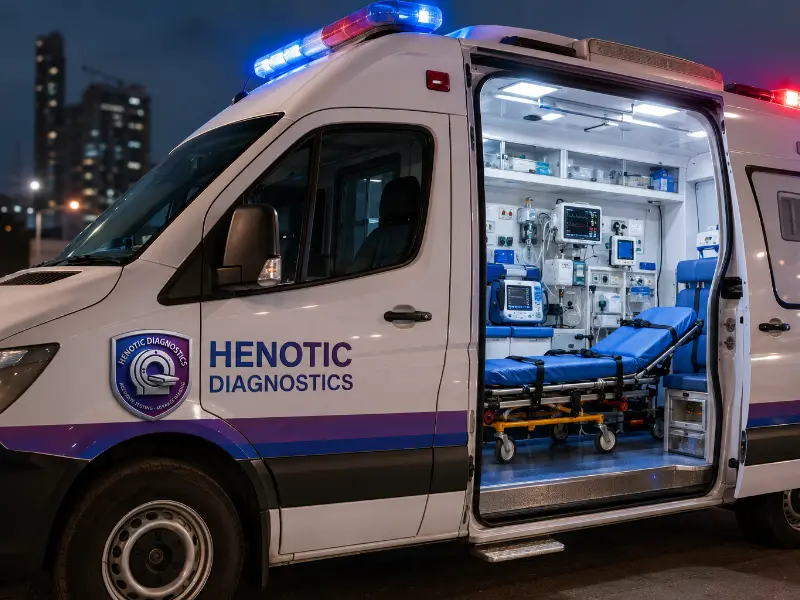
Each stretcher ambulance carries the following standard equipment. However, the exact setup may vary based on the patient’s needs:
| Equipment | Purpose |
|---|---|
| Hydraulic Stretcher | An adjustable-height patient bed with tilt control and secure straps for safe transit. |
| Oxygen System | Portable cylinders (2–10 L/min) with mask and nasal tube for patients needing breathing support. |
| Vital Monitoring | Includes BP cuff, pulse oximeter, temperature sensor, and single-lead ECG for continuous tracking. |
| Suction Unit | A portable device for airway clearing in patients with fluid or choking risk. |
| First-Aid & AED | Contains a standard trauma kit, splints, bandages, and an automated external defibrillator. |
| Transfer Aids | Additionally includes slide sheets, positioning cushions, safety belts, and patient-moving boards. |
| Stair Equipment | A stair-chair and carry-chair are available for buildings without lift access. |
Why Choose Our Stretcher Transport?
Safe Patient Handling
Our crew is trained in lifting, positioning, and securing bedridden patients. This includes staircase movement and working in tight spaces.
Round-the-Clock Dispatch
Because emergencies don’t follow a schedule, our booking line runs 24 hours a day, 365 days a year — covering hospital discharges, early-morning appointments, and late-night needs.
Condition-Matched Setup
Depending on the patient’s medical needs, the stretcher type, oxygen, monitoring devices, and crew size are selected before dispatch.
Experienced Medical Crew
Consequently, every ambulance carries at least two trained people — an EMT and a patient-handling helper — while a doctor is available for critical cases.
Comfort-Focused Design
Furthermore, the vehicle cabin features smooth suspension, climate control, and cushioned stretcher surfaces to reduce patient discomfort during the ride.
One-Call Booking
Simply share the patient details, pickup point, and destination. After that, we handle vehicle selection, crew assignment, and scheduling on our end.
Stretcher vs Wheelchair Ambulance
Not every patient needs a stretcher. In contrast, some can travel safely while seated. Here is a quick comparison to help you decide:
| Factor | Stretcher Ambulance | Wheelchair Ambulance |
|---|---|---|
| Patient position | Lying flat | Seated in wheelchair |
| Bedridden patients | ✓ | Not suitable |
| Post-surgery patients | ✓ | Only for stable cases |
| Spinal / fracture patients | ✓ (with body support) | Not suitable |
| Elderly who can sit | Available but may not be needed | ✓ |
| Oxygen support | Available | Limited options |
In other words, if the patient can sit safely, a wheelchair ambulance may be more fitting and cost-friendly. However, for patients who must stay lying flat, a stretcher ambulance is needed.
How to Book — 4 Simple Steps
First, call our helpline with the patient details. Then, we take care of the rest:
Describe the Patient
Share the condition, mobility, weight, oxygen needs, and building access (stairs or lift).
Provide the Route
Next, tell us the pickup address, destination (hospital, home, clinic), and preferred date and time.
Confirm & Schedule
After that, we assign the right stretcher, crew, and equipment. Then booking time is confirmed.
Safe Transfer
Finally, the crew arrives, loads the patient securely, monitors vitals, and delivers them safely.
What Affects Stretcher Transport Cost?
Naturally, pricing varies because each patient transfer has different needs. The main factors that affect the cost include:
- Distance — the total kilometres between pickup and destination.
- Waiting time — for example, hospital discharge delays or appointment waiting periods.
- Equipment needed — whether oxygen, monitoring, a stair-chair, or a heavy-duty stretcher is required.
- Trip type — one-way, return, or multi-stop journeys all differ in pricing.
- Crew size — either the standard two-person crew or extra handlers for complex cases.
- Time of day — although standard rates apply during daytime, overnight or holiday transfers may cost more.
To get a custom quote, call 088793 27184 with the patient’s details.
Frequently Asked Questions
What is a stretcher ambulance?
Essentially, it is a medical vehicle with an adjustable stretcher, built to transport patients who cannot sit upright — including bedridden, post-surgery, and spinal-injury patients.
Who needs stretcher transport?
In particular, it is used by bedridden patients, post-surgery patients who must lie flat, elderly people with severe mobility problems, and anyone who needs to stay in a lying position during travel.
Can you handle stairs?
Yes, our crew carries stair-chairs and patient-lifting tools for buildings without lift access. Because of this, please describe the building layout when booking so we bring the right gear.
Is oxygen available?
Indeed, portable oxygen cylinders with masks and nasal tubes are available on board. Just specify the flow-rate needed during booking.
Can a family member ride along?
In most cases, one person can travel inside the ambulance alongside the patient. However, this should be confirmed at booking based on vehicle space.
How much does it cost?
Since every transfer is different, the price depends on distance, equipment, waiting time, crew size, and trip type. Call with patient details for an accurate quote.
How quickly can you arrive?
Typically, dispatch takes about 30–60 minutes in urban areas. For planned transfers, we suggest booking at least 2 hours in advance.
Is monitoring provided during the ride?
Yes, basic vital-sign tracking (BP, pulse oximeter, temperature) comes standard. Additionally, advanced monitoring with ECG can be arranged for higher-risk patients.
Do you help with hospital discharge coordination?
Certainly — our crew works with hospital nursing staff for a safe bed-to-stretcher transfer. Meanwhile, discharge paperwork remains the hospital’s task.
What if the patient needs more than basic support?
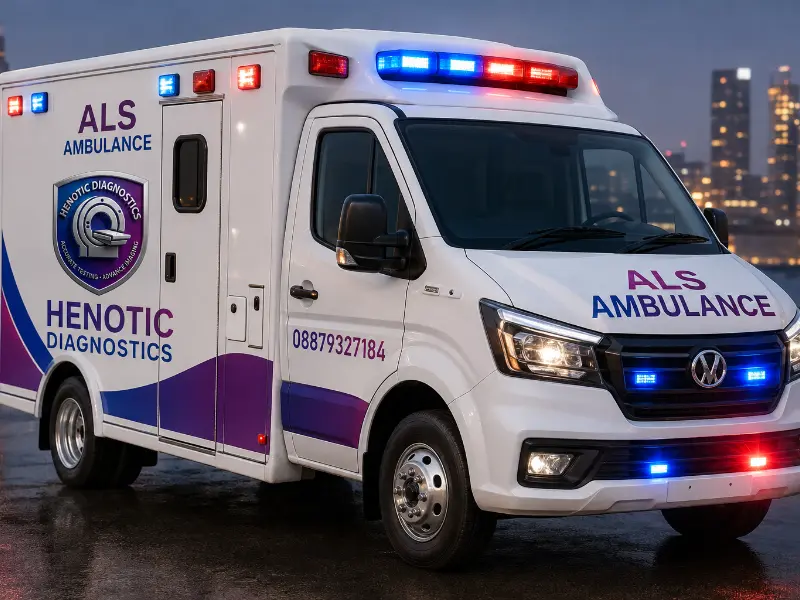
If the patient requires ICU-level care, a ventilator, or advanced heart monitoring, then an ICU ambulance or ALS ambulance would be more suitable.
Related Ambulance Services
Not sure if a stretcher ambulance is the right fit? Alternatively, explore our other transport options below:
BLS Ambulance
Basic stretcher transport with oxygen and monitoring for stable patients who need simple medical support.
Wheelchair Ambulance
On the other hand, patients who can sit safely may prefer an assisted wheelchair vehicle for their journey.
ICU Ambulance
Meanwhile, critically ill or ventilator-dependent patients need a mobile intensive-care unit instead.
Contact Henotic Diagnostics


Henotic Diagnostics
📍 Address: Second floor, Millennium Empire, Business Park, Plot No 47, D Mart Rd, Sector 15, Kharghar, Panvel, Maharashtra 410210
🗺️ Google Maps:
 Get Directions
📞 24/7 Helpline: 088793 27184
🕒 Opening Hours: Open 24 hours, 365 days a year